
King Johnnie Games, Slots and Live Tables
 Available in AU
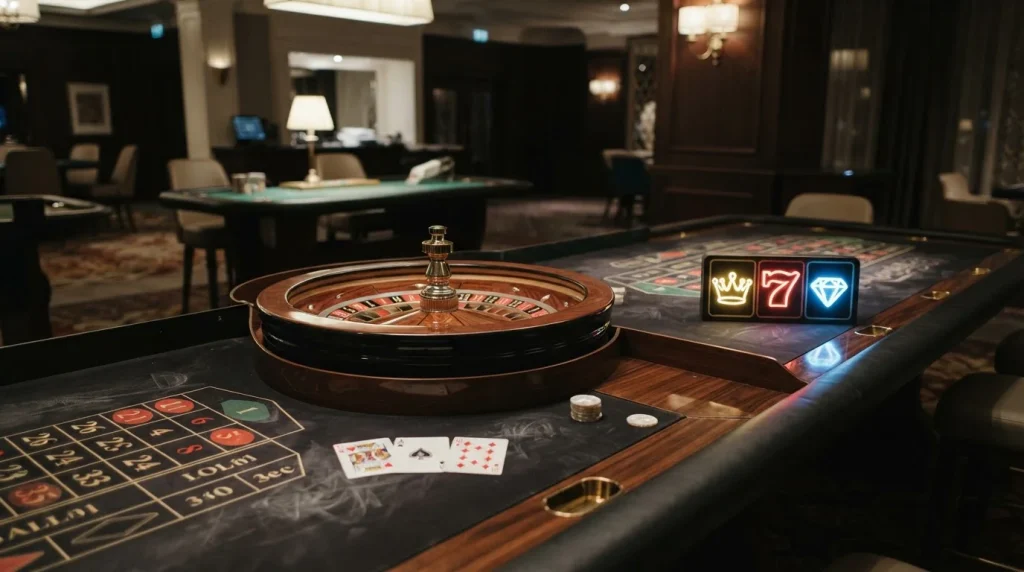
King Johnnie brings together video slots, jackpots, table games, live-dealer formats and shorter instant-style titles. Different kinds of games create different rhythms of play, while a broad catalogue does not by itself reveal the expected return of an individual title.
Table of Contents
- Game studios and the shape of the catalogue
- Slot categories, jackpots and feature volatility
- Roulette, blackjack, baccarat and live tables
- RTP, house edge and what a session can actually show
- Crash, keno, bingo and shorter play formats
- Mobile viewing, game interruptions and account controls
- Frequently asked questions
- Game variety matters most when its rules are understood
Game studios and the shape of the catalogue
King Johnnie is associated with a mixed casino lobby spanning conventional video slots, live-dealer tables and smaller instant-style categories. A catalogue listed 4,728 titles on 15 October 2026. The count reflects the selection at that time, not a promise that every title remains in rotation. Game catalogues change when suppliers revise distribution agreements, when a title is withdrawn or when a particular device cannot display it.
Across independent catalogue descriptions, the studio totals run from 31 to 40. Those totals reflect different listings and should be read as a range of catalogue coverage, not a claim that precisely that number of studios is always active. Named suppliers include Quickspin, Yggdrasil, Betsoft, Playson, BGaming, Wazdan, Pariplay, Habanero, Relax Gaming and PG Soft. The mix matters because the studio develops the game mathematics, visual design and interface conventions, while the casino organises access through its lobby.
A provider name is useful for recognising a familiar design family, but it does not establish a universal return percentage or a common maximum prize for all of that studio’s games. Two slots released by the same supplier can have different volatility, feature frequency and paytable structure. Nor should the size of a provider list be mistaken for the number of distinct game engines: a catalogue can include multiple configurations and variants of a single theme.
The broad inventory is most useful when separated by interaction style. A reel game resolves a random event after a spin; a blackjack or baccarat hand follows a different set of choices and house rules; live tables add a video connection to a human dealer. Sorting the lobby by the kind of decision being made is more informative than comparing the raw number of icons on the screen.
| Category | Typical interaction | Important distinction |
|---|---|---|
| Video slots and jackpots | Spin with payline or ways evaluation | Bonus features and volatility differ |
| Blackjack and video poker | Decision-based card rounds | Rules and strategy affect theoretical outcomes |
| Roulette and baccarat | Table bets with defined outcomes | Bet type changes the house advantage |
| Live dealer | Streamed table session | Connection quality and pace matter |
| Crash and scratch-style titles | Short repeated decisions or reveal | Rapid session tempo can raise exposure |
Slot categories, jackpots and feature volatility
The slot catalogue includes reel games and jackpot-oriented titles, with titles supplied by the named studios. Slot mechanics vary substantially: some games award frequent small wins while others concentrate part of their return in rarer bonus rounds. A screen showing a jackpot amount does not tell the player how frequently the jackpot is won, what eligible bet applies or how much of the return is allocated to that feature.
Volatility is a description of the distribution of possible results, not a promise of the result from any specific number of spins. In a high-variance game, a long sequence of losing outcomes is compatible with the published mathematical model. A low-variance game can deliver more frequent small returns while still carrying a house advantage. The practical issue is the risk of mistaking short-term fluctuations for a change in the underlying probabilities.
Paylines, winning ways and cluster pays are different evaluation systems. With paylines, combinations normally occupy specified lines. Ways-based slots evaluate matching symbols across positions under the game rules. Cluster titles group symbols on neighbouring positions. These mechanics change how outcomes are presented; none in itself indicates which game has the higher return or lower risk.
Jackpot branding also needs a distinction between a fixed prize and a progressive pool. A fixed jackpot is a stated feature of a specific game; a progressive pool may grow with qualifying activity over participating platforms. For King Johnnie’s game categories, the important distinction is how the rules of each title define and fund its jackpot. A category label alone cannot support a numerical prize projection.
Autoplay and fast-spin modes, when present in an individual game, can change how rapidly money is committed without changing the underlying expected return per wager. A session of many small bets can therefore generate a much larger cumulative stake than the balance initially displayed. The effective session cost depends on bet size, number of rounds and the game’s real mathematics.
Roulette, blackjack, baccarat and live tables
King Johnnie’s described table catalogue includes roulette, blackjack and baccarat, with live blackjack, live roulette and live baccarat as distinct live-dealer formats. Roulette follows a wheel-and-bet structure; blackjack adds draw and stand choices under a particular rule set; baccarat centres on the result of two compared hands. Video representations and live streams can deliver the same broad game category with different pacing and interface demands.
In blackjack, details such as the number of decks, dealer action on soft seventeen and rules around doubling and splitting influence the theoretical edge. It would be misleading to apply one percentage to all blackjack titles simply because they share a name. Baccarat has different wager types and different odds for those types; the familiar “banker”, “player” and “tie” labels do not make the bets equivalent in expected cost.
A live table incorporates a real-time video feed and a scheduled or continuous dealing process. That changes the user experience, including the ability to observe the sequence of a hand, but it does not remove the mathematical house advantage. A slow stream or interrupted connection also creates a practical distinction between a visual delay and a disputed game outcome.
Video poker is another decision-based category listed for King Johnnie. The paytable is essential: two machines with the same name can assign different awards to common hands. In addition, strategy assumptions matter when a published theoretical return is calculated. The screen appearance alone cannot serve as a substitute for reading the paytable and relevant rules.
Comparing tables is best done through three questions: which variant is being displayed, what rules govern each decision, and how quickly are stakes being placed? The same nominal stake can lead to different total turnover depending on round length. A live setting may feel more deliberate but can still involve substantial cumulative exposure over a long session.
- Identify the specific game variant and its rule sheet.
- Separate the game’s stated return from short-term outcomes.
- Consider the number of rounds as well as the size of each stake.
- For a dispute, preserve the game identifier, transaction reference and sequence of events.
RTP, house edge and what a session can actually show
Return to player (RTP) is a long-run statistical ratio of total returns to total stakes under the relevant mathematical model. A theoretical RTP of 96% in a hypothetical game would correspond to an expected house edge of 4%, but neither number predicts the result of an individual session. The illustrative figures explain the arithmetic only; they are not King Johnnie game figures.
The house edge is a percentage of amounts wagered, not simply a percentage of a starting balance. If a hypothetical session contains repeated stakes, the total amount put into play can far exceed the funds initially set aside. This is why a small-looking per-round bet can still represent meaningful cumulative financial risk, especially when an interface makes another round effortless.
Theoretical return also should not be conflated with the frequency of winning rounds. A game can show many modest wins and still return less overall than the cumulative stakes. Conversely, a title designed around occasional larger prizes may have a wide range of short-session outcomes. Neither pattern creates a reliable way to predict when a particular prize will appear.
Independent fairness concepts such as cryptographic verification must be attached to a specific game and its published verification process. A casino accepting cryptocurrency does not automatically make its games provably fair. Similarly, a provider brand name alone is not an audit report. The meaningful evidence for a given title is its rules, paytable and applicable independent testing information, where such material is actually supplied.
Players comparing display formats should also recognise that visual design is not a measure of expected return. Animated wins, celebratory audio and near-miss arrangements are presentation elements. They may affect the perception of frequency and momentum even when the mathematics is unchanged. A clear numerical record of stakes and outcomes is a stronger basis for understanding a completed session.
Crash, keno, bingo and shorter play formats
The wider King Johnnie selection also includes crash titles, keno, bingo and scratch-style products. Those categories create a different rhythm from conventional reel and card games. Crash formats usually present a changing multiplier and a choice about when to end exposure; keno centres on number selections; bingo evaluates patterns; scratch-style titles reveal a predetermined game outcome through a compact animation.
The fact that a crash interface appears to reward timing does not mean a visible pattern in previous rounds provides a dependable forecast of the next one. Each game has its own rules and randomisation model. A sequence of recent multipliers, however striking, is not a substitute for the game mathematics, and stopping rules do not turn a house-advantaged game into a predictable income stream.
Keno and bingo can use quite different prize tables. The number of selected positions, size of the drawn pool and required match pattern all influence probability. A game bearing a familiar category label can still have a different prize structure from another game in the same lobby. The paytable and the exact selection rules are therefore central to understanding any example calculation.
Fast-repeating formats deserve attention because their session length can be measured in seconds rather than minutes. The risk is less about an individual round in isolation than the ease of entering many rounds without consciously adding up the committed amounts. Reviewing cumulative stake and time is more useful than focusing only on the latest win or loss.
For a broad view of the brand’s non-game conditions, payment-method categories explain how cards, wallets and cryptocurrency differ. That context matters when comparing an on-screen game balance with money actually moved between accounts, even though these are separate stages of a user’s experience.
Mobile viewing, game interruptions and account controls
Descriptions of King Johnnie’s mobile access mention both a browser-based experience and a progressive web app. In practical terms, a browser-based experience places the lobby within the device’s normal web environment. A progressive web app is a method of presenting a website with certain app-like characteristics; its presence does not automatically indicate a separate downloadable native application.
Smaller screens make paytable details and game histories easier to overlook. A game that works well on a desktop can still require scrolling to read information about paylines, bonus features and limits. Session interruptions matter particularly for live tables, where a connection issue can occur between placement of a wager and display of its outcome.
A disconnected screen does not necessarily mean a round has been cancelled. Game providers and platforms ordinarily track an outcome through identifiers or server records. A person examining a disputed event should distinguish a delayed display from a repeated charge, and should retain the game identifier, timing and associated balance record where available.
King Johnnie’s associated service descriptions include English-language live chat. That contact channel is relevant to reporting a game interruption, and the brand’s broader account and verification conditions also matter when an issue requires identity checks or supporting evidence. The topics are linked operationally without making a technical problem proof of any particular payout outcome.
The main way to compare this catalogue is by recognising the game category, rules, pace and potential cumulative stake. A large supplier lineup brings different formats into one lobby, but no inventory total or colourful interface substitutes for understanding the mathematics and financial exposure of a session.
- Use the game title and exact variant when identifying a disputed event.
- Keep a record of the time and transaction or round identifier.
- Read the relevant paytable rather than relying on a general category label.
- For financial harm or gambling distress, use independent support rather than extending play.
Frequently asked questions
Which game categories are associated with King Johnnie?
The catalogue includes slots, jackpots, roulette, blackjack, baccarat, video poker, bingo, keno, crash and live-dealer tables.
Which live tables feature in the catalogue?
Live blackjack, live roulette and live baccarat feature in the described selection.
Does the number of listed games remain fixed?
A catalogue listed 4,728 titles on 15 October 2026. Inventory changes as titles and supplier coverage change.
Can RTP predict a short gaming session?
No. RTP is a long-run mathematical measure; individual sessions can end far above or below that theoretical percentage.
Game variety matters most when its rules are understood
King Johnnie groups several distinct forms of casino play under one catalogue, from reels and jackpots to live cards, table wheels and rapid-format titles. The practical differences lie in their rules, decision points and pace. Studio names and lobby counts help describe the breadth, while paytables, game mechanics and cumulative stakes explain the financial exposure of any particular session.